Tag: fiction

  • Blog #9- Permitting a Placid Pulse

    I do like the notion we’re analyzing, the exclusion of statistics in favour of placing one’s finger on the pulse, feeling the blood pulsate, circulating, and knowing why, because you took the initiative to ask. To understand. Citations 86’d.

    Communities must be included as a driving force, as to leave them out is to throw accuracy to the wind, to break trust, subjectivizing every topic, every character, until you’ve squeezed the entire soul from the story. Make them your collaborators, not your serfs.

    The narrative references in “When The Sound is Frozen” are freaking sick. I may have to include a similar sort of cataloging in my future works. Experiment with that medium to say the least.

    I’d like to improve upon utilizing narrative extraction, in a fashion that utilizes the other resounding sensory factors when listening to someone talk about a topic. Fuck what they say, what do they sound like?(still hear what they say, just make sure to listen for more) How do their eyes look when they choke that sentence out? Forage for the grit. To enthrall. I want their stories to hold me captive, bind my arms, hold my tongue, so that which i do take is more meaningful. As a concoctor of verbally or visually transmitted symbols, I must remember- As purveyor of prescribed notions, it’s not my duty to sand them down to textureless nothings, but my job to make sure the audience can feel every knot, every offset grain in the wood, so that their hand is dragged so carelessly, lost in captivation, that they get splinters. Something real. Tangible.

    Writing and research are not neutral. The expression of anything aligns with the topic in a fashion that harbors responsibility for it to a certain degree. Real policies, real environments, and lives are shaped by such. I believe there is often fail to recognize this.It really boils down to an ever-resounding theme often neglected today; the art of listening. Slow it down, get messy, break a concept whilst trying to understand another- be more human.

  • Blog #7- where my So(u)les have gone

    I chose De Certeau. Although seen by many as ridiculously pseudointellectualized, I adore it.

    Walking In The City is very Tolkien-esque stylistically. Linguistically, I suppose. De Certeau talks about standing above the city — looking down from the skyscraper, where everything looks clean and orderly. He calls it a “God’s-eye view.” How we’ve built these massive, humming machines of efficiency — cities, algorithms, industries — all designed to make movement predictable. The characterization of how we’ve built this world of certainties around us, to lock ourselves into a labyrinth of calculated eventualities. Everything is mapped, planned, down to the millimetre. We’re supposed to walk the straight lines, follow the signals, and stay in sync with the rhythm of the machine. That damn machine. This boils down to our constant quest for comfortability, for explanation(why people are religious). This is precisely why I love this concept. Existence is predicated upon interpretation, as we know. I want to be swayed, finding comfort in dissecting this reality, but too often I find myself leached with more melancholy than not. A silent gargantuan humbling of that which just is our actuality. It shows how easily we get absorbed into these systems — the “machine” of industrialization, capitalism, whatever you want to call it — where we think we’re making choices but really we’re just walking the paths someone else designed. Infinite caveats.

    Slugs. I love linking this video. It’s satire, it’s me, and its so real, and so self aware in it’s futile silliness. Check it out. It’s almost wholesome. Mr.putyouon.

    Upon revisitation.

    I cannot say that the third read of this piece definitively altered by intake of it more than the prior two, but the writing and assignments I’ve undergone since then certainly have. I am lost without my GPS in a new city, a newborn babe chained to dependency upon my “personal” machine, that is just an extension of my dependency on the actual machine. I find myself often wrapping my mind into these rantings of industrial society, oh you’re just an ant you’re just a bug. Haha. You are. I am. De Certeau likens walking to “existing outside of your blueprint, which is both trivial and beautiful, as it’s just a physical arm of defining your existence. I guess that’s what i like the most. The physical take on subconscious, conscious rebellion. For the sake of yourself.

    As Edward Abbey says, “growth for the sake of growth”. We’re all just on Crete, either looking for the exit of the labyrinth, happily wandering it, or in constant dismay that your purpose is to wander it. Looking for what? More? Something…right?

    Where have your soles gone, where do you want them to go, and what shoes will you wear? How will that change where you end up? How will that shape your soul? Very nifty indeed.

  • Activity #7- Wizard. Core.

    So. For my artifact I have chosen a widely fluctuating meme format deemed loosely as “wizardcore”. This entails images that embody any sort of mystical vibe or aesthetic, and for my purposes, include a wizard or a figure clothed in “traditional wizarding garments”.

    Example.

    this is a wizardcore meme, detailing two frogs not being high. They're wearing steezy robes.

    Here we have two humble frog lads, dripped out to their tails in flowing robes, contemplating just how intoxicated they may be. The conclusion: not even high.

    In terms of circulation, I will be using the format in general, not any specific picture, as that is what prompts the widespread nature of this meme template. It can convey anything the creator wills it to, which is why it is so dearly utilized. The term “wizard” itself originated from Middle English, as wys, meaning wise, or wise-man. The “ard” was later tacked on. Although this meme format has been around for a decade or so, it really exploded in 2022 on tiktok, with a slideshow format of wizardly images, with captions like “typa $hit i been on”. This was used to describe scenarios stemming from any sort of root; unemployment, to fantasies about what people wished they could be doing, or how they’d like to choose to view their life. It really boils down to a romanticization of peoples’ inner intentions, the human yearning for a more simplistic, puritan reality. I adore this, as I view it as an effect of how brutalistically concrete and lifeless our reality has become in so many fashions. This “wizardcore” seeks to cast a soft golden light over our frivolous societal struggles.

    These examples do not embody a purely positive, negative, or neutral appropriation, therefore they are able to transcend a simplified impact. Archaic images from 20th century artwork are often used, such as one of the first main posts by @thatsgoodweb in 2021 captioned “Pondering My Orb”. As stated, this later blossomed in 2022, but as far as I can find this is one of the first to utilize such an image in this fashion. Inspiration is often taken from LOTR which is pretty rad, as I consider that the epitome of modern fantasy, with many environmental and life lessons packed into the realm of Middle Earth. While I do not believe the original circulators of this format were, or even could be aware of the popularity that would ensue, it’s always keen to assume that eventuality when creating and sharing anything on the vast interweb.

    Admittedly, I adhere to these romantic notions of a transient, otherworldly depiction of many things, as it softens the asphalt around our eyes, allowing us to paint a reality that is indeed, very real, we are just detached. So detached, and discombobulated from the truly ethereal. And that’s the beauty of it.

  • Blog #5- Communication Control

    Here we are, floundering in yet another rhetorical medium. Lovely. We’re back to third spaces: the cigarette stained stoops, the pavilion amongst the felled oak trees; those spaces in which existence is less so guided, and more so encouraged. Except now, they’re magazines. Zines, to be specific. These are basically small-form printed written works, often including visual elements, sort of pocket books for the people if you will.

    Upon exploring a few zines on the internet archive, I was not convinced they can be considered third spaces within themselves. I’d say that they can be a very useful medium for circumventing constricting idealisms, but they’re a medium. There is no reflected discourse within them exactly, it’s the discourse that exists around them in the communities they help curate. One could say, well third places in general are just a medium. The place is just a place until you define the place. And I would have to agree. So, I suppose there is essence in claiming them as a place for conversation. For expression. An extension of the imagination if you will. I suppose the main issue is interacting with them digitally. I’d hope for some sort of chat feature or digital discussion room, as that would complete the third place definition for me. Zines are akin to posters, to songs, to notes scribbled then tucked into the drawer of International. They are simply another means to an end.

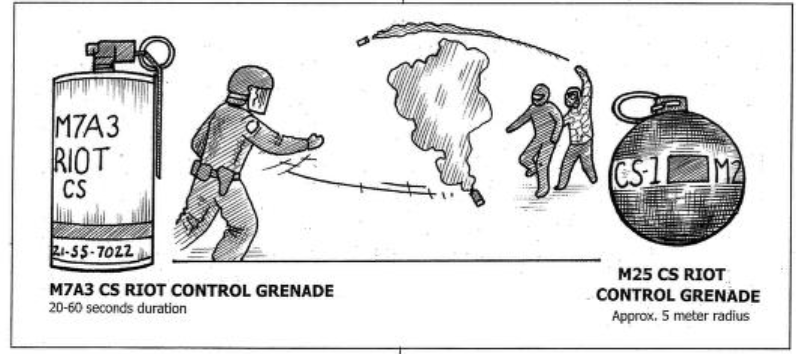
    That being said I do dig some of Licona’s sentiments regarding imagination as within the realm of positive application. That it is indeed productive to endorse one’s imagination, that it transcends escapism. It’s a nice thought, with a lot of truth to it. Among explored zines was the Warrior Crowd Control and Riot Manual . It was neat. Here’s a little taste for you.

    a zine showing how to use riot control grenades, and how to combat them. It also shows the types of grenades- M7A3 CS, and M25 CS

    Tear gas types mainly utilized by police and military are detailed. One smells like apple blossom, one smells like pepper. Both will make you cry.

    While I feel someone could consume any type of media and be receptive to it, depending on both the topic at and, and their interest in it, I have enjoyed the images in these zines. The sort of pamphlet feel makes for a bit more of a hands-on vibe. Very effective for spreading rhetoric. I can already picture an “Earth First” zine in detail; Erika facing down bulldozers in Northern Arizona. Straight out of Hayduke Lives!

    I still don’t think zines are really third places(my earlier logic says otherwise) but I can understand and appreciate the niche they fill in spreading rhetoric, especially within marginalized movements or for more guerilla sectors, which they seem to be perfectly suited for. Dropping little zine manifestos from the sky. Soon enough. Sound familiar?