itookthepillyougaveme
school. stories. sensations.
recent posts
about
melancholic madness
-

Digital Thread of Transcribed Things
Di ital Thr ad of Transcr bed Thi gs
-
Digital Thread of Transcribed Things
Di ital Thr ad of Transcr bed Thi gs
-
Digital Thread of Transcribed Things
Di ital Thr ad of Transcr bed Thi gs
I strongly dislike a lot of things.
Digital spaces can include or exclude their audiences through any and all design choices. The formatting, background, and font of every button is a signaler of the virtues the hope to portray.
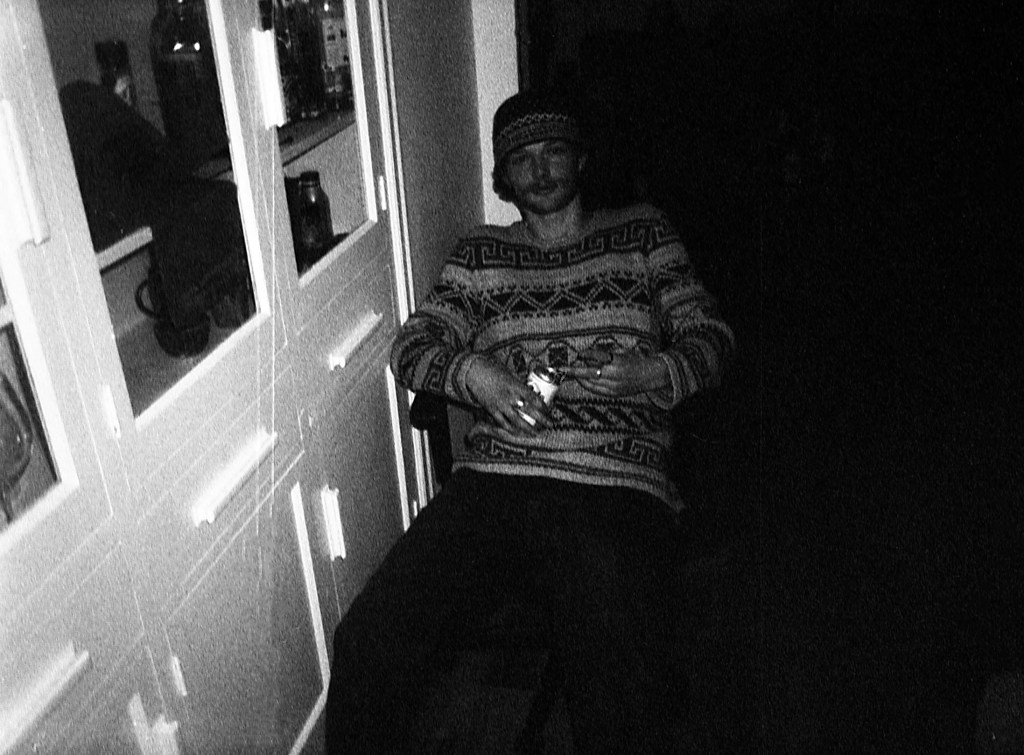
(exclusionary bloke)
I have a habit of being exclusionary with my work. It isn’t necessarily to slight those excluded, it’s more of a filter I place both consciously and subconsciously. As with any artist’s work, they are the most aware of the target audience, therefore part of that perception is wrapped into the work itself. The piece presents itself in drastically different ways each individual, allowing for a myriad of possible perceptions. For example, you could say this blog is ableist due to there being no text to speech option, yet the gray area found in digital mediums is the adaptability of it. Every device you could consume this on would have a text to speech option, so you’re sort of let off with those regards. Digitized stuff ey. My website is relatively redundant, both in content and available navigation controls.
Art is inherently exclusive. Always has been, always will be.
Let’s say I were to read this site’s posts from another set of eyes, ones’ less tainted by the horrors of our reality, or perhaps just more optimistic ones. I’d find whatever bloke who is writing this material a bit insufferable, in the sort of way where he’s making a good point, while being a bit of a prick about it. He babbles over all those matters you’ve just never cared enough to mull over, the ones that float just a little too far above what you call reality. There’s something soothing about it, the ingestion of a rant that doesn’t shatter your world.
“inclusion often sustains exclusion while pretending to fix it”
I cannot detail the ins and outs of what I am catering to in regards to the needs of my readers. As with most things I do, it simply is not for them. It would be disingenuous to trade my integrity for a more consumable medium. They can find their corporate slop bowl somewhere else. However, in all seriousness, I make it a priority that each post contains at least two or more mediums. Hyperlinks to images, videos, and definitions are commonplace here. I’ve updated all images in past posts to include alternative text, allowing for a wider
-
Digital Thread of Transcribed Things
Di ital Thr ad of Transcr bed Thi gs
I open it again. Flip forward until it’s blank. Yes. Spit it out. The page is lonely; colourless, not neglected no, just not discovered yet. Waiting to say, “hello, aren’t you the prettiest little fuck-up” . An Icarian Fall.
Dimensions: about three inches by six. 3/4 inch thick. Red. Like a shitty rose.
It’s important understand that this space is not for you. It’s mine. It does, however, bleed into my life, obscuring my eyes, guiding them with a lens of madness, of unremorseful appreciation. Know this; if it’s italic, it’s direct from the red space. Lucky you, fuck you think?
As Max says “Dude what if we were dogs” Bro’s so real.
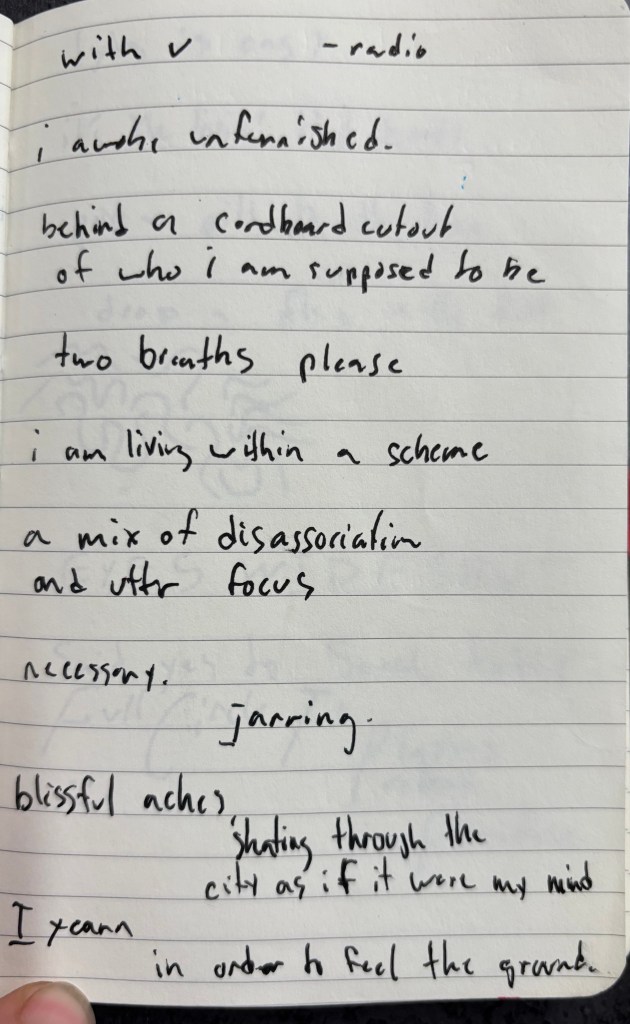
a page from the space. Real, not tantalizing, close, not the brilliant illumination of ideals, but real. Truly real. What is? Whatever I allow, only what I allow to be.
Forward 10 pages. A brilliance I receive beyond my power to make. Suddenly I know I have passed to a shore where I do not live. I see now, what I thought was part of the light, is part of the dark.
It’s far too easy to get lost in here. I visit it everyday, and I still find myself slipping down the wrong hallway, sliding into one of the flooded rooms, the ones where the bulbs are burnt out. Most of what you find here is text, partially recognizable characters scribbled up and down the lines- 23 per page. You are often directed to a external work, one that does not exist within this space. Look! Go read The Industrial Society and it’s Future! Sink deeper into the depravity of this world under the false moniker of intellectualism. If you’re lagging behind the class, this space is a book, or rather an empty book waiting to be filled with text. It exists anywhere I exist, tagging along in my back pocket, chomping at the bit when any predicament or experience comes my way, eager to catalogue and commentate.
Look closer, and you will find surprisingly deep pools of sorrow.
Check out Hannah Arendt
Lost again. Flip back to the beginning. Reread it. This time you’ll understand, this time you’ll enact it.
Max and I with our hazy IPAs, we sit in the beargrass, admiring the lichen, discussing the whys of what has been, and the prospects of things to come. There you are. That is the start. Of this space. It’s really the middle of this chapter, however for our purposes that’s all you need know. It flits between the tangible and that which is only applicable in the mind, it exists because you will it to, you prune it and cherish it all whilst fearing what it reminds you of- yourself.
This is not inclusive, nor is it exclusively selective. This space exists so that you may tamper with yourself in the safety of language. A third space only in ideals. This special issue.. blah blah blah… does whatever you want it to do. That’s why it’s not a third space. It’s more personal, more intuitive, a leper of fantastical notions.
Are you there? You must be with me. There are pages, it is red, you know how many lines per page, you know there things that have been written. You do not know what they mean. You are not me. This is not your space. Sometimes, it barely feels like mine. Whatever this has meant to you, try to replicate the negligence of it’s nuance in your own way. Build your own little space of everythings and nothings. Collect your things too dear to speak aloud, and tuck them with purpose, hide them from all that ails, so that you may one day become what you hold so dearly.
If found: Contact XXX-XXX-XXXX
Reward: A spliff and a hug

a hyperlink within an image, an
image from a page of the space -
Digital Thread of Transcribed Things
Di ital Thr ad of Transcr bed Thi gs
Disability disclosure-the ins and outs of there being no real proper way to enact the public’s understanding of a predicament only truly understood by the plagued. An act of disclosure becomes a “dance of perturbation and response,” meaning the writer puts something into the world, and the world responds, often unpredictably. I enjoyed her matter of fact tone, not one to beat about.
Kershbaum underlines three main purposes for disability disclosure(academically).
-Building Community
-Illustrating Theory
-Claiming Identity
Upon ingesting this piece, I became wrapped up in the infinity of nuance one must undergo when attempting to disclose their disability, without marring their message, image, or composure. The idea that you could disclose it flawlessly, with a smooth, collected action, only to be met with a coagulation of condescending responses(half conscious, half subconscious) is a bit disheartening. So is our world, is it not?
The format did make me feel. Surprised. Taken aback. Flummoxed. This isn’t fair.
Now. Different format of expression, addressing an adjacent facet of the same umbrella phenom: discrimination.
So, a Twine game, basically. I found this one to depict the jarringly marginal nature of the healthcare system very well due mostly to it’s format, and partially to the nature of the language used. It certainly is structured to resonate with the reader in a tangible fashion, one which drives the message home deeper. Although perhaps a bit less well rounded than Kershbaum’s in terms of in depth explanations, it offered more soul to the reader. Also, it’s a game, so naturally, higher retention is almost a definite.
Now, in tandem please.
Obviously, the intention of each piece was to invite discussion on what it means to disclose personal events and struggles that frame a larger issue, and whether they’re effective at doing so. The personification of society’s pitfalls; a very common form of expression. One’s ability to utilize agency is displayed, then questioned, then deployed again. I’m not going to sit here and reach out to try and corroborate these pieces to past items, as they all share traits, as everything in our world does. it is certain that all pieces used this semester have been different modes of rhetoric, all trying to persuade, to teach, to entertain, hiding behind the facade of their topics being “morally just” or “progressive”. At the end of the day, they are all simply varying forms of propaganda, just as the words you read now are. And that’s okay. I do enjoy discourse upon agency, why some have more and some have less, why we are afforded different privileges based on false sequitives.
And so, in that way, I know that such works are important, as what do we have, if not the agency to discuss, to disagree, and the right to utilize the machine’s rhetoric to our favour. Exploration through dissemination.
-
Digital Thread of Transcribed Things
Di ital Thr ad of Transcr bed Thi gs
I do like the notion we’re analyzing, the exclusion of statistics in favour of placing one’s finger on the pulse, feeling the blood pulsate, circulating, and knowing why, because you took the initiative to ask. To understand. Citations 86’d.
Communities must be included as a driving force, as to leave them out is to throw accuracy to the wind, to break trust, subjectivizing every topic, every character, until you’ve squeezed the entire soul from the story. Make them your collaborators, not your serfs.
The narrative references in “When The Sound is Frozen” are freaking sick. I may have to include a similar sort of cataloging in my future works. Experiment with that medium to say the least.
I’d like to improve upon utilizing narrative extraction, in a fashion that utilizes the other resounding sensory factors when listening to someone talk about a topic. Fuck what they say, what do they sound like?(still hear what they say, just make sure to listen for more) How do their eyes look when they choke that sentence out? Forage for the grit. To enthrall. I want their stories to hold me captive, bind my arms, hold my tongue, so that which i do take is more meaningful. As a concoctor of verbally or visually transmitted symbols, I must remember- As purveyor of prescribed notions, it’s not my duty to sand them down to textureless nothings, but my job to make sure the audience can feel every knot, every offset grain in the wood, so that their hand is dragged so carelessly, lost in captivation, that they get splinters. Something real. Tangible.
Writing and research are not neutral. The expression of anything aligns with the topic in a fashion that harbors responsibility for it to a certain degree. Real policies, real environments, and lives are shaped by such. I believe there is often fail to recognize this.It really boils down to an ever-resounding theme often neglected today; the art of listening. Slow it down, get messy, break a concept whilst trying to understand another- be more human.
-
Digital Thread of Transcribed Things
Di ital Thr ad of Transcr bed Thi gs
So. Aja Y. Martinez is marginalized. Or ostracized. Oppressed. Downtrodden by privilege, essentially. She’s experiencing one of the more common social phenoms in the Western World as a whole- the incessant stereotyping of people, often based upon their presenting phenotype. Whether that be woman, colour, or disability, it’s long been rampant, most noticeably in white collar environments.
Martinez argues that one of the easiest indicators of privilege is assessing comfortability; the more comfortable, the more privilege. Referenced is the “somatic norm”, the idea that each society fabricates a common normality of actions, appearance, and demeanor, categorized by the dominant or creational race in that particular society. Therefore, their actions set the standard for assimilating groups.

My personal relation to this will consist mostly of assisting in Martinez’s bashing of shallow “allyship”. This is admittedly one of my pet peeves in general, as any disingenuous, or worse, half-assed portrayal of any ideal or movement, I find abhorrent. Now, there are probably things that I pretend to care about a bit more than I actually do, but I don’t virtue signal with them, they are not worn on my sleeve. I’ll die on the ragtag hill of my opinions.
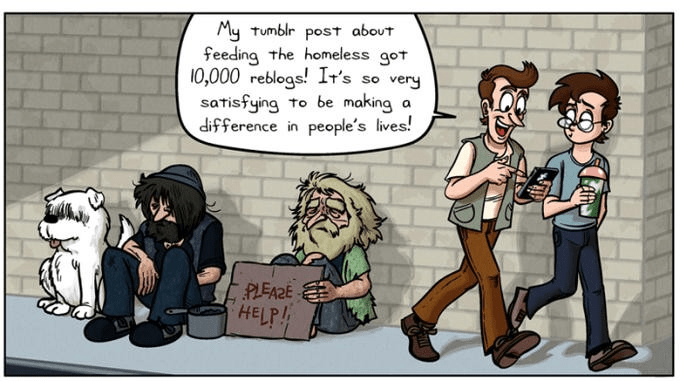
A good example would be the black square era on Meta platforms. people just posting this shit in faux solidarity, to simply gain clout or moral high ground by virtue signaling their asses off is insufferable. I’m a firm believer in the idea that if you don’t have anything actually meaningful to do, it’s better to do nothing.
-
Digital Thread of Transcribed Things
Di ital Thr ad of Transcr bed Thi gs
I chose De Certeau. Although seen by many as ridiculously pseudointellectualized, I adore it.
Walking In The City is very Tolkien-esque stylistically. Linguistically, I suppose. De Certeau talks about standing above the city — looking down from the skyscraper, where everything looks clean and orderly. He calls it a “God’s-eye view.” How we’ve built these massive, humming machines of efficiency — cities, algorithms, industries — all designed to make movement predictable. The characterization of how we’ve built this world of certainties around us, to lock ourselves into a labyrinth of calculated eventualities. Everything is mapped, planned, down to the millimetre. We’re supposed to walk the straight lines, follow the signals, and stay in sync with the rhythm of the machine. That damn machine. This boils down to our constant quest for comfortability, for explanation(why people are religious). This is precisely why I love this concept. Existence is predicated upon interpretation, as we know. I want to be swayed, finding comfort in dissecting this reality, but too often I find myself leached with more melancholy than not. A silent gargantuan humbling of that which just is our actuality. It shows how easily we get absorbed into these systems — the “machine” of industrialization, capitalism, whatever you want to call it — where we think we’re making choices but really we’re just walking the paths someone else designed. Infinite caveats.
Slugs. I love linking this video. It’s satire, it’s me, and its so real, and so self aware in it’s futile silliness. Check it out. It’s almost wholesome. Mr.putyouon.
Upon revisitation.
I cannot say that the third read of this piece definitively altered by intake of it more than the prior two, but the writing and assignments I’ve undergone since then certainly have. I am lost without my GPS in a new city, a newborn babe chained to dependency upon my “personal” machine, that is just an extension of my dependency on the actual machine. I find myself often wrapping my mind into these rantings of industrial society, oh you’re just an ant you’re just a bug. Haha. You are. I am. De Certeau likens walking to “existing outside of your blueprint, which is both trivial and beautiful, as it’s just a physical arm of defining your existence. I guess that’s what i like the most. The physical take on subconscious, conscious rebellion. For the sake of yourself.
As Edward Abbey says, “growth for the sake of growth”. We’re all just on Crete, either looking for the exit of the labyrinth, happily wandering it, or in constant dismay that your purpose is to wander it. Looking for what? More? Something…right?
Where have your soles gone, where do you want them to go, and what shoes will you wear? How will that change where you end up? How will that shape your soul? Very nifty indeed.
-
Digital Thread of Transcribed Things
Di ital Thr ad of Transcr bed Thi gs
So. For my artifact I have chosen a widely fluctuating meme format deemed loosely as “wizardcore”. This entails images that embody any sort of mystical vibe or aesthetic, and for my purposes, include a wizard or a figure clothed in “traditional wizarding garments”.
Example.

Here we have two humble frog lads, dripped out to their tails in flowing robes, contemplating just how intoxicated they may be. The conclusion: not even high.
In terms of circulation, I will be using the format in general, not any specific picture, as that is what prompts the widespread nature of this meme template. It can convey anything the creator wills it to, which is why it is so dearly utilized. The term “wizard” itself originated from Middle English, as wys, meaning wise, or wise-man. The “ard” was later tacked on. Although this meme format has been around for a decade or so, it really exploded in 2022 on tiktok, with a slideshow format of wizardly images, with captions like “typa $hit i been on”. This was used to describe scenarios stemming from any sort of root; unemployment, to fantasies about what people wished they could be doing, or how they’d like to choose to view their life. It really boils down to a romanticization of peoples’ inner intentions, the human yearning for a more simplistic, puritan reality. I adore this, as I view it as an effect of how brutalistically concrete and lifeless our reality has become in so many fashions. This “wizardcore” seeks to cast a soft golden light over our frivolous societal struggles.
These examples do not embody a purely positive, negative, or neutral appropriation, therefore they are able to transcend a simplified impact. Archaic images from 20th century artwork are often used, such as one of the first main posts by @thatsgoodweb in 2021 captioned “Pondering My Orb”. As stated, this later blossomed in 2022, but as far as I can find this is one of the first to utilize such an image in this fashion. Inspiration is often taken from LOTR which is pretty rad, as I consider that the epitome of modern fantasy, with many environmental and life lessons packed into the realm of Middle Earth. While I do not believe the original circulators of this format were, or even could be aware of the popularity that would ensue, it’s always keen to assume that eventuality when creating and sharing anything on the vast interweb.
Admittedly, I adhere to these romantic notions of a transient, otherworldly depiction of many things, as it softens the asphalt around our eyes, allowing us to paint a reality that is indeed, very real, we are just detached. So detached, and discombobulated from the truly ethereal. And that’s the beauty of it.
-
Digital Thread of Transcribed Things
Di ital Thr ad of Transcr bed Thi gs
Here is my pamphlet.

 itookthepillyougaveme